

Triple i Logistics believes that every employee is valuable and is at the heart of driving sustainable business growth.
We place importance on treating employees fairly and equitably.
The Group places importance on treating employees in accordance with labor protection laws strictly and opposes all forms of unfair labor practices, including child labor and forced labor. As the quality of life of employees is of utmost importance, the Group has established appropriate working hours, provides compensation and benefits sufficient for a decent standard of living, and promotes continuous training and development to enhance the capabilities of all employees.
Compliance with Labor Laws and Regulations

The Group places importance on treating employees in accordance with labor protection laws, employment contracts, social security laws, the Labour Protection Act, the Social Security Act, the Workmen’s Compensation Act, the Occupational Safety, Health, and Environment Act, the Skill Development Promotion Act, the Quality of Life Development Act, the Labour Relations Act, and other relevant labor laws strictly. Additionally, the Group studies international labor standards, including the United Nations Guiding Principles on Business and Human Rights (UNGP) and the International Labour Organization (ILO) Declaration on Fundamental Principles and Rights at Work, to ensure that all employees receive proper care and a good quality of work life.



“Work-Life Balance” - Measures for Employee Working Hours and Overtime Management

The Group places the highest importance on creating work-life balance, alongside employee health and safety. To prevent accumulated fatigue, the Group has established systematic measures to monitor employee working hours to ensure they do not exceed the limits prescribed under the Labour Protection Act B.E. 2541, as well as regulations regarding overtime aligned with labour protection laws, as follows:
Respecting Rights and Rest Periods:
The Group manages overtime and holiday work appropriately. Prior written approval from the supervisor and the employee’s consent are required on a case-by-case basis. The total number of overtime hours, holiday work hours, and overtime on holidays must not exceed 36 hours per week as stipulated by law. In addition, where overtime of at least 2 hours is required after normal working hours, employees must be provided with a rest period of no less than 20 minutes prior to commencing the overtime work.
Manpower Management to Reduce Workload:
During peak seasons when transportation and warehouse activity volumes are higher than usual, the Group implements measures to reduce excessive working hours by engaging daily wage workers as supplementary support in warehouses, to reduce the workload burden on permanent employees, ensure employees receive adequate rest, and mitigate long-term health risks.
Compensation and Benefits Management System

The Group is committed to treating all employees equally and fairly, with a comprehensive compensation and benefits management system to enhance employee quality of life, as follows:
Fair Compensation Management:
The Group determines compensation and benefits based on economic conditions and the cost of living, while taking into account the scope of responsibility of the position, nature of work, qualifications, profession, knowledge, skills, and performance as important considerations, to ensure competitiveness in the labor market. Currently, the Group’s compensation is benchmarked against the same industry. Furthermore, the Human Resources Department continuously monitors minimum wage regulations to ensure that employees receive fair compensation and benefits that are not lower than the minimum standards prescribed by law.
Welfare Programs Beyond Compliance:
The Group is committed to ensuring employees receive sufficient income to maintain a decent standard of living. Accordingly, the Company provides a range of welfare programs and additional benefits that exceed the minimum requirements prescribed by law, such as provident fund contributions, health insurance for employees covering their children, accident insurance, emergency loans, and financial assistance for important life events including marriage, ordination, childbirth, and in the event of the death of a family member, as well as employee uniforms, to alleviate financial burden, strengthen financial security, and sustainably improve the quality of life of employees and their families.



Training and Development (Strategy-Driven Learning)
The Group is committed to enhancing employee capabilities through a Strategy-driven Learning approach, designed to develop areas of weakness and build existing strengths. In 2025, a Training Need Metric was developed to systematically analyze employee development requirements focusing on three strategic levels: Individual Needs, Functional Needs, and Organization Needs, to ensure that employee development is aligned under a unified direction and consistent standards across the organization, enabling employees to apply acquired knowledge to their work and create long-term value for both employees and the organization.
Furthermore, the Group has designed learning processes that integrate theory with practical application. The Group incorporates the “70:20:10 Model” into its training framework, consisting of:
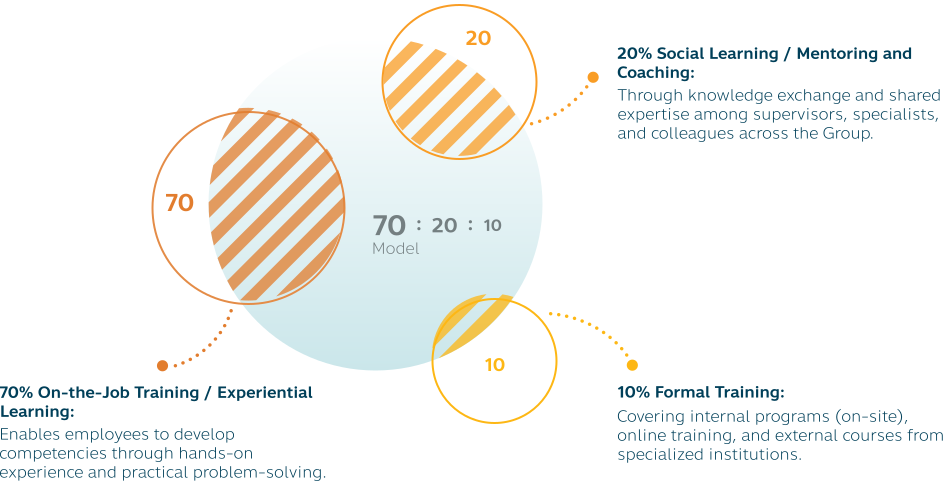
The Group also places importance on well-rounded skill development, covering hard skills, soft skills, and critical future skills, to ensure that employees at all levels are equipped to adapt effectively to rapidly evolving business, technological, and workplace environments.
In addition, line supervisors conduct performance and career development reviews at least annually to support stable and sustainable employee growth alongside long-term organizational success.